Science at Bethlehem Star Pre & Primary School is mostly read about rather than done. This program changes that — not by building a laboratory the school could never afford to maintain, but by bringing reusable STEM kits, robotics and coding directly into the classroom, and training teachers to lead the work themselves.
Project at a glance
- Location: Bethlehem Star Pre & Primary School, Usa River, Arusha
- Pupils reached: 400+ in Classes 3–7
- Teachers trained: up to 10
- Duration: first academic year, in two phases
- Funding target: TZS 8,050,000
- STEM partner: MITzKITS
- Coordinated by: Tupendane Foundation and Initiatives (TUFOI)
Why it is needed
A conventional science laboratory costs more to build and maintain than a community school can realistically raise. Consumable materials and fragile equipment add a recurring cost on top of that. The practical result is that science becomes theoretical — pupils learn the words for things they have never handled.
Teachers face a parallel problem. They are committed to their pupils, but few primary educators get the chance to train in robotics, programming, or technology-enabled teaching methods. And children who reach secondary school without early exposure to computers, algorithms and problem-solving start at a disadvantage that widens over time.
How the program works
Reusable kits instead of a laboratory
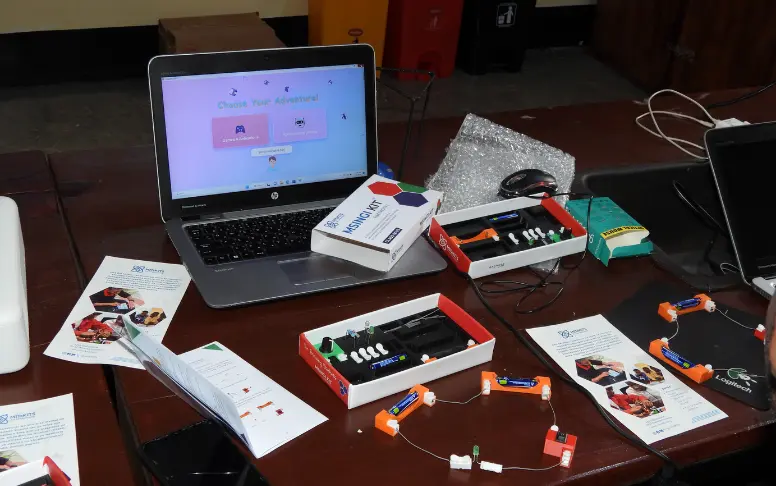
The kits are durable and portable, containing electrical circuits, mechanical components, sensors, basic robotics equipment and practical science materials. Because they move between classrooms and are used again each year, a modest number of kits can serve hundreds of pupils — without a permanent laboratory.
Teachers first
Up to 10 teachers receive hands-on training in delivering practical STEM lessons. This is the part that determines whether the program outlives its funding. The goal is for teachers to run these activities independently rather than depend on visiting trainers.
Supervised workshops
MITzKITS trainers co-lead workshops alongside school teachers, covering mechanics, electronics, science experiments, robotics, coding and collaborative problem-solving. Working in pairs means teachers learn by doing while pupils get structured, safe instruction.
Aligned to the national curriculum
Activities are designed to complement the Tanzanian primary curriculum rather than sit beside it, strengthening existing mathematics and science teaching while adding practical digital skills.
Two phases
Phase 1 — foundation. A two-day intensive teacher training, followed by two supervised introductory workshops for pupils covering mechanical movement, basic electronics and practical science. Starter kits support pupils working in groups, with remote technical support for teachers between sessions.
Phase 2 — expansion. Pupils in Classes 3–7 move on to robotics, basic coding, algorithms, sensors and automated machinery. Teachers attend a two-day refresher seminar, four further supervised workshops run, and specialised robotics and coding kits expand what the school can teach.
What it costs
| Component | Phase | Cost (TZS) |
|---|
| Teacher training masterclass, 2 days, up to 10 educators | 1 | 950,000 |
| Introductory pupil workshops, 2 days | 1 | 900,000 |
| Basic reusable STEM kits, supporting 30 pupils | 1 | 1,500,000 |
| Refresher teacher seminar, 2 days | 2 | 400,000 |
| Advanced supervised workshops, robotics and coding | 2 | 1,800,000 |
| Expanded specialised STEM kits | 2 | 2,500,000 |
| Remote teacher support and curriculum consultation | All year | Included |
| Total, Year 1 | | 8,050,000 |
Just under half of this is physical equipment that stays at the school as a permanent teaching resource.
What success looks like
By the end of the first year, teachers should be able to run practical STEM, electricity and basic mechanics lessons without external supervision. Hands-on activity should be a normal part of maths and science teaching in Classes 3–7. And more than 400 pupils should have working knowledge of spatial logic, motor movement, coding syntax, algorithms and practical robotics — demonstrated through pupil exhibitions rather than assessed on paper alone.
Beyond the first year
If the model works here, it creates a foundation for robotics bootcamps, a community innovation space, and vocational computer training — and a case that practical technology education can be delivered in an under-resourced school without capital-intensive infrastructure. That is the part with the potential to travel to other primary schools in Arusha and beyond.
Partners
TUFOI coordinates the program, providing supervision, community engagement, financial management and donor reporting. TUFOI is a registered Tanzanian NGO, registration number OONGO/R/2425, and publishes independently audited accounts each year.
MITzKITS supplies the STEM kits, curriculum alignment, technical expertise and teacher training.
Bethlehem Star Pre & Primary School hosts the program. The school has 481 pupils and 34 staff, and already has a solar power system and clean-water borehole installed through earlier TUFOI projects.
Support this program
We are seeking TZS 8,050,000 to deliver the first year. Contributions of any size go toward teacher training and equipment that stays with the school.